

The selection of forklift models and configurations generally takes into account the forklift's operational functions, operational requirements, and operating environment. Such as warehouse size, ground conditions, channel width, etc. By comprehensively analyzing these factors, the type, tonnage, and configuration of the required forklift can be determined. The following are the considerations for forklift selection:
1. Indoor or outdoor work environment: It is recommended to choose an electric forklift indoors to reduce emissions and noise; Outdoor environments typically require powerful diesel forklifts. Channel width: Narrow aisle warehouses require the use of narrow aisle forklifts (VNA) or forward moving forklifts to accommodate limited operating space.
2. Goods type and characteristics Goods weight: Overweight goods require the selection of forklifts with high load capacity while ensuring load stability. Size and shape of goods: Overlong or irregular goods may require side forklifts or specialized attachments. Storage method: The stacking height and shelf design will directly affect the lifting height requirements.
3. Climate conditions and low temperature environment: Forklifts with anti low temperature configurations should be selected for cold storage, such as using low-temperature adapted batteries and lubricants. High temperature environment: It is recommended to equip forklifts with strong heat dissipation capabilities to avoid overheating. Wet environment: Forklifts with anti-corrosion design should be selected to extend equipment life.
4. Food and pharmaceutical industries require forklifts to meet strict cleaning and hygiene standards. It is recommended to use electric forklifts or stainless steel forklifts. Dangerous goods transportation: must comply with safety standards and be equipped with explosion-proof devices
When selecting specific forklifts, we need to refer to the following parameters to make selection recommendations:
(1) Forklift tonnage configuration The weight of different goods and the highest fork height determine the load configuration of the forklift. As the fork height increases, the safe load capacity of the forklift will gradually decrease. For example, a 2T electric forklift can carry 2T of cargo when operating at a low position, but when the forklift reaches a height of nearly 5 meters, its safe load capacity may only be 800KG or up to 1000KG, and exceeding this weight may pose a danger.
(2) Forklift drive. There are mainly electric forklifts, as well as diesel forklifts; Due to the involvement of indoor and outdoor operations, two configuration ratios are considered.
(3) Forklift lifting height. Choose the appropriate lifting height based on the requirements of elevated warehouse operations and the height of the warehouse. Usually, the combination of low-level and high-level tasks can reduce the total procurement cost. The lifting height of forklifts should be appropriately considered from the standard configuration of 3 meters, 4 meters, 5 meters, 6 meters, 7 meters, and 10 meters+.
(4) Forklift mast height. Considering that forklifts need to enter the interior of the container for operations, the height of the gantry must meet the requirement of a net height of less than 2.3 meters inside the container, with at least two gantry sections. However, it should be noted that there may be a conflict between the lifting height and the height of the gantry, which needs to be balanced.
(5) Sideshifter configuration. To improve the accuracy and flexibility of forklift operations, it is recommended to install a side shifter.
(6) Tire quantity selection: Choose a three wheeled or four-wheel forklift based on the width of the work channel, with a smaller turning radius for a three wheeled forklift.
(7) Maintenance costs. Maintenance costs are also an important factor to consider. For electric forklifts, DC motors or AC motors should be chosen, and further distinction should be made between full AC and partial AC, as this will directly affect subsequent maintenance costs.
(8) Minimum turning radius. The minimum distance from the outermost and innermost sides of the forklift body to the turning center when driving at low speed without load and turning the steering wheel at full capacity is called the minimum outer turning radius and the minimum inner turning radius, respectively. The smaller the minimum outer turning radius, the smaller the ground area required for forklift turning and the better its maneuverability.
(9) Considering the width of the forklift operation channel. When it is not possible to purchase high cost forklifts, it is also necessary to consider whether to choose three or four wheels, as the turning radius of three wheels is much smaller.
Storage forklifts are mainly designed for handling goods in warehouses. During multi shift operations, motor-driven storage forklifts require backup batteries:
(1) Electric pallet handling forklifts have a carrying capacity range of 1.6-3.0 tons, with a typical operating channel width of 2.3-2.8 meters and a fork lifting height of approximately 21cm. They are mainly used for horizontal handling and cargo loading and unloading in warehouses. There are generally two operating modes: walking and station driving, which can be adjusted according to efficiency requirements
(2) Forward moving forklifts have a carrying capacity of 1.0-2.5 tons, and the gantry can be moved forward or retracted as a whole. When retracted, the width of the operating channel is generally 2.7-3.2 meters, and the lifting height can reach up to about 11 meters. They are commonly used for stacking and picking up goods at medium to high heights in warehouses.
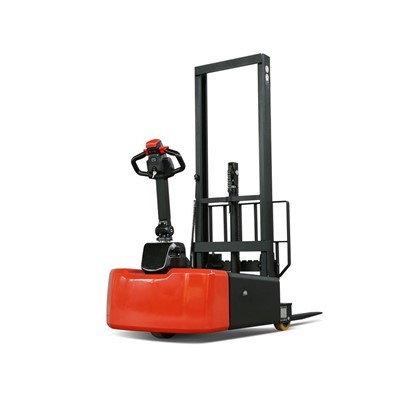
(3) The carrying capacity range of the stacker crane is 1-1.6 tons, the width of the operating channel is generally 2.3-2.8 meters, and the lifting height of the fork is generally within 4.8 meters. It is mainly used for stacking and loading/unloading goods in the warehouse.
The stacker crane has a simple structure, flexible operation, good micro motion, and high explosion-proof safety performance. Suitable for operations in narrow passages and limited spaces, it is an ideal equipment for palletizing in elevated warehouses and workshops. Widely used in industries such as petroleum, chemical, pharmaceutical, textile, military, paint, pigment, coal, as well as ports, railways, freight yards, warehouses and other places containing explosive mixtures for loading, unloading, stacking and handling operations. It can greatly improve work efficiency and reduce the labor intensity of workers.
Stacker - Classification
1. Manual hydraulic stacker crane (without any power device, relying entirely on manual pushing and pulling for lifting, with a small turnover radius and laborious lifting) 2. Semi electric stacker crane (using hydraulic device, electronic control components and lifting gantry, manual pushing and pulling for front and rear steering, electric lifting, with a small turnover radius and convenient flexibility)
3. All electric stacker crane (self-propelled electric lift, easy to use, fast)
Stacker - Main features:
1. Has high stability.
2. Low noise, pollution-free, and low failure rate.
3. The gantry moves forward and backward, with a small turning radius.
4. Raise the height high, suitable for high-rise stacking.
(4) Balance weight forklift
1) Electric forklift. Powered by an electric motor and powered by a battery, with a carrying capacity of 1.0~4.8 tons and a working channel width of 3.5~5.0 meters, it is suitable for indoor operations and other environments with high environmental requirements.
2) Ordinary internal combustion forklift. Generally, diesel, gasoline, liquefied petroleum gas or natural gas engines are used, with a load capacity of 1.2-80 tons and a working channel width of 3.5-5.0 meters. They are commonly used in outdoor, workshop or other industries for exhaust emissions. In situations where there are no special requirements for noise and noise. (5) The three-way stacking forklift is divided into two types: high position driving and low position driving. The forklift can stack and pick up goods on both sides without turning. The channel width is 1.5~2 meters, and the lifting height is about 12-14.5 meters. Its unmanned driving solution can even increase the height.
Narrow aisle three-way forklift is a special type of forklift that can operate in narrow passages. Its main features are:
1. Both the main and auxiliary wheels can rotate freely 360 degrees, which can effectively handle narrow operating spaces.
2. It can travel in both directions in narrow alleys, improving the efficiency of goods entry and exit.
3. Goods can be stored and picked up on higher shelves to maximize warehouse space utilization.
Common application scenarios include: currently widely used in industries such as mechanical manufacturing, chemical, pharmaceutical, as well as in supermarkets, shopping malls, food cold storage and other places to carry out loading, unloading, storage, handling, and stacking operations.
How to choose between shelves and forklifts to reduce collisions?
1. When planning the warehouse, it is possible to request the shelf manufacturer to increase the width of the incoming shelf channel appropriately and reserve some safety distance for drivers in advance, which can reduce the collision of forklifts with cow legs;
2. Adding protective covers on cow legs or guardrails, although this method can reduce forklift damage to the shelves, it provides an opportunity for some drivers with poor technical skills, making it difficult for management personnel to judge the driver's operating level;
3. Drawing visual speed reduction lines on the ground of the passage instead of speed reduction signs often results in a certain distance between the measured and actual differences due to experienced drivers driving at a faster speed. Therefore, a simple speed reduction sign may not be very effective;
4. Installing fork gear sleeves on forklifts can effectively reduce damage to the edges and corners of the pallet caused by forklifts; However, whether this method is feasible or not, it is best to undergo safety testing by forklift manufacturers.
How To Select Forklift Equipment




Send Inquiry