

What are the types of forklifts? 10 common types, no longer confused after reading
In the operation and management of warehousing and manufacturing industries, the selection of forklifts directly affects operational efficiency and cost control. Different types of forklifts determine whether enterprises can achieve efficient handling in limited spaces, and also affect equipment utilization and long-term investment returns. But for managers, selection is only the first step, and more importantly, ensuring that these devices have sufficient safety guarantees during operation. This article will review ten common types of forklifts and their typical application scenarios, and further explore the common safety system configurations on forklifts, helping managers make more scientific decisions in equipment configuration and safety management.
Ten common types of forklifts and their advantages and disadvantages
1. Balance weight forklift
The most common type of forklift is equipped with a fork directly at the front for easy operation. Suitable for warehouses, factories, and flat indoor and outdoor floors. There are various fuel options available (electric, diesel, gas), with a load range from 1.4 tons to over 28 tons.
Advantages: sturdy, multifunctional, and highly adaptable
Disadvantages: Large turning radius, poor maneuverability in narrow spaces
2. Forward moving forklift
Known for its high lifting height, it is particularly suitable for warehouses equipped with high-rise shelves. The driver operates from the side, with good visibility and control.
Advantages: Flexible and adaptable, suitable for narrow passages, strong high-level storage capacity
Disadvantage: It requires a flat ground and is not suitable for complex outdoor environments
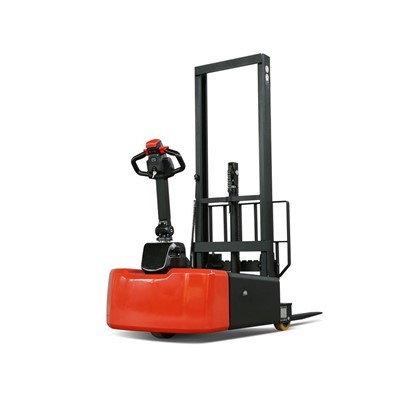
3. Stacker crane
Mainly used for vertical stacking of palletized goods, commonly found in warehouses and distribution centers. The operator needs to walk behind the equipment to operate it.
Advantages: Improved efficiency, suitable for stacking palletized goods
Disadvantages: Requires walking operation, poor ergonomics
4. Tray handling vehicle (electric or manual)
Compact in size, suitable for short distance and low position handling, commonly used in supermarkets, warehouses, and workshops. Some electric models can handle goods weighing up to 3 tons.
Advantages: Low cost, easy to learn, flexible operation
Disadvantages: Unable to increase height, limited handling efficiency
5. Articulated forklift
Equipped with a rotatable articulated chassis, capable of turning and operating in narrow passages. Suitable for storage environments with limited space.
Advantages: Small turning radius, high lifting height, good space utilization
Disadvantage: High ground requirements, aisle still needs to be wider than VNA
6. VNA forklift (narrow aisle forklift)
Specially designed for extremely narrow channels, the channel width can be as narrow as 1.6 meters, and the lifting height can reach up to 18 meters. Some models support the operator to lift and lower with the fork.
Advantages: Maximum storage density, efficient operation, and excellent field of view
Disadvantages: High cost, specific application scenarios
7. The picking car is used for manually picking scattered items and can lift the operator to the height of the shelf, suitable for fast turnover of small and single items.
Advantages: Easy sorting, high lifting height
Disadvantage: Only suitable for warehouses with simple layout and frequent picking
8. Off road forklifts are designed specifically for outdoor complex road surfaces, with strong power and durable tires, commonly found in construction sites, forest farms, etc.
Advantages: Strong power, able to handle rough road surfaces
Disadvantages: Large size, not suitable for indoor use
9. The telescopic arm forklift (telescopic loader) is equipped with a telescopic arm, which can install various accessories and has both lifting and handling functions. Commonly used in agriculture, construction, and manufacturing industries.
Advantages: Multi purpose, high lifting height, off-road capability
Disadvantages: Poor maneuverability and high demand for turning space
10. Side mounted forklift
Suitable for transporting long goods (wood, steel, pipes, etc.), the fork is located on the side of the vehicle and can be operated horizontally in narrow passages.
Advantages: Designed specifically for long cargo, improving the utilization of narrow spaces
Disadvantages: Limited applicability, mostly used in specific industries
The common challenge of forklifts: safety risks
Different types of forklifts have their own characteristics, but they face highly similar safety challenges during use. Whether it is a forward moving forklift for indoor storage or a telescopic forklift for outdoor construction sites, the risk of accidents often concentrates on several aspects:
Personal injury: Common accidents include collisions, falling goods, foot pressure, etc
Equipment damage: damage to shelves and vehicles caused by operational errors or limited visibility
Working environment restrictions: Narrow passages, complex road surfaces, or high-level operations may all amplify safety hazards
Management difficulty: When multiple forklifts coexist, the implementation of safety standards and operating procedures becomes more difficult
This means that the diversity of forklifts does not bring about "differentiation" in terms of risks, but rather reminds us that no matter which forklift a company chooses, safety systems and protective measures are necessary investments. Only by incorporating safety design and technological means into equipment configuration can forklifts truly leverage their advantages in efficiency and cost control. Next, we will introduce common forklift safety systems to help managers have a more comprehensive understanding of how to reduce accident risks through the combination of technology and management.
Common safety systems on forklifts
In forklift management in enterprises, operator training alone is not enough to completely avoid accidents. Introducing security systems can reduce the risk of human error through technological means. Overall, these systems can be roughly divided into two categories: active safety and passive safety.
1. Active safety system (preventing accidents) The core goal of an active safety system is to "prevent in advance" and reduce dangerous behavior through monitoring, control, and reminders:
Speed control system: automatically limits speed in bends, specific areas, or when speeding to avoid overturning or collisions caused by excessive speed
Personnel identification and permission control: Use card swiping, facial recognition, or password to activate the forklift, ensuring that only qualified operators can use the equipment
Collision warning system: using lasers, ultrasound, or radar to detect obstacles and personnel, and issuing timely warnings or interventions
Area sensing and diversion system: such as blue lights and projected warning lines, providing clear traffic boundaries for pedestrians and forklifts
2. Passive safety system (reducing the degree of injury)
Passive safety systems cannot prevent accidents from occurring, but can reduce the loss of personnel and equipment in the event of an accident:
Seat belts and seat protection: prevent operators from being thrown out of the driver's seat in the event of a rollover or emergency stop
Protective frame and cab structure: such as roof protection frame, to reduce the harm of cargo falling to operators
Anti pressure foot device: Especially important on pallet trucks or low-level forklifts, it can automatically stop or reverse in case of collision, protecting the feet of operators
Automatic power-off and emergency braking device: quickly cuts off power when abnormal situations are detected, reducing further injury
If you need further customized demonstration services or detailed explanations of exclusive solutions, please feel free to contact us by private message at any time.
Forklifts come in various types, meeting the handling needs of enterprises in different scenarios.
No matter which model is chosen, safety is always the core that cannot be compromised in management.
For managers, true competitiveness lies not only in improving equipment efficiency, but also in balancing efficiency and safety through systematic security configuration and management.
Choosing the right forklift is productivity; Choosing a good security system is the guarantee.
What Are The Types Of Forklifts? 10 Common Types, No Longer Confused After Reading




Send Inquiry